
Is Leaky Ductwork Making Your Home Less Comfortable?
DUCT SEALING · VANCOUVER ISLANDHeated and cooled air can escape through gaps in your ductwork before it ever reaches your rooms. Island AeroBarrier commonly finds leakage of about 30% when testing residential duct systems — even when tape or mastic is visible.
Aeroseal seals those hidden leaks from inside the duct system, and the system is measured before and after — so the result is a number, not an opinion.
Vancouver Island’s licensed and certified Aeroseal provider since 2018.
COMMON WARNING SIGNS
Do any of these problems sound familiar?
Duct leaks are usually hidden behind walls, above ceilings or beneath floors. You may never see the leak — but you may already be living with the effects.
One room is always too cold
A single room never reaches the thermostat setting, whatever the season.
Upstairs gets too hot
The upper floor holds heat while the main floor stays comfortable.
Energy bills keep rising
Heating and cooling costs climb with no change in how you use the system.
Some vents have weak airflow
You can barely feel air at certain registers even when the system runs.
The home gets dusty quickly
Surfaces need dusting again only days after cleaning.
The HVAC runs for long periods
The furnace, heat pump or air conditioner runs far longer than it should.
THE HIDDEN CAUSE
Where does the air go?
Every duct system can leak, regardless of its age. Because residential ducts are generally not required to be leak-tested after construction, a system can look sealed from the outside while still losing a significant amount of air.
HVAC system
Produces heated or cooled air
▶
▼
Ductwork
Carries the air through the building
▶
▼
Your rooms
Receive whatever survives the trip
WHERE THE CONDITIONED AIR CAN ESCAPE INSTEAD
Attics
Crawlspaces
Garages
Wall cavities
Unconditioned areas
Supply-side leaks send air where nobody lives
Leaks in supply ducts release heated or cooled air into attics, crawlspaces, garages, walls and other unconditioned areas. The equipment may be producing plenty of air — less of it is arriving where you need it.
Return-side leaks pull unwanted air in
Leaks in return ducts draw dust, odours, insulation particles, humidity and unfiltered air from surrounding spaces into the system, which then circulates it through the home.
Island AeroBarrier commonly measures about 30% leakage in residential systems.
WHY DUCT LEAKAGE MATTERS
A small leak can create problems throughout the home
Comfort
When conditioned air escapes before reaching the rooms, some spaces receive less heating or cooling than others. That creates hot and cold spots, weak airflow, and rooms that never seem to match the thermostat.
What sealing may help improve — more conditioned air reaching the intended rooms, supporting more balanced airflow and steadier temperatures.
Energy efficiency
Air that escapes into an attic, crawlspace, garage or wall cavity is energy you have already paid for but never used. Island AeroBarrier commonly sees about 30% duct leakage during testing.
What sealing may help improve — more of the efficiency purchased at the furnace, heat pump or air conditioner is delivered into the home instead of lost on the way.
Indoor air quality
Leaks in return ducts pull dust, odours, insulation particles, humidity and unfiltered air from surrounding spaces into the system. That unwanted air is then circulated through the home.
What sealing may help improve — fewer openings for air from attics, crawlspaces, garages and walls to enter the duct system in the first place.
HVAC performance
A high-efficiency furnace, heat pump or air conditioner is rated under controlled conditions. Connected to leaky ductwork, the efficiency delivered to the rooms can be dramatically lower. The Department of Energy study referenced by Island AeroBarrier indicates that 30% duct leakage can reduce delivered system efficiency by about 50%.
What sealing may help improve — the system gets to operate closer to the efficiency it was rated for, protecting the value of the equipment.
REPLACE — AEROSEAL PROCESS VISUAL
Sealant travelling through the duct and collecting at the edge of a leak. Recommended 1000×750. Replace this Text module with an Image module, or swap in the supplied asset.
THE SOLUTION
Seal hidden duct leaks from the inside
Aeroseal distributes a specialised vinyl acetate sealing material through the duct system. The material stays in the airflow until it reaches the edge of a leak, where it collects and forms a seal — closing gaps that would otherwise be invasive or impossible to reach by hand.
The duct-sealing formula is different from the acrylic material used for building-envelope sealing.
Hidden leaks ▶ Aeroseal ▶ Measured result
Holes and cracks up to 5/8″ wide can be completely sealed
Ducts hidden from view can still be sealed
The sealant collects at the holes — it does not coat the ductwork
HOW IT WORKS
From hidden leaks to measurable results
Six steps, start to finish — with the duct system measured before and after.
01
Assessment
We review the duct system and talk through what you are noticing in the home.
02
Preparation
Registers are blocked off and the HVAC equipment is protected before any sealing begins.
03
Baseline testing
A pre-seal test establishes the existing leakage, giving progress a real starting point.
04
Duct sealing
Sealant enters the pressurised duct system and is carried to the leaks by the escaping air.
05
Monitoring
A computer and sensors measure and control progress while the system is being sealed.
06
Final verification
A post-seal test measures the improvement, and a report and certificate are printed on the spot.
MEASURED PROOF
See how much leakage was sealed
Every Island AeroBarrier duct project is tested before and after. The figures below will be published from a verified project report.
BEFORE — MEASURED LEAKAGE
——
AWAITING VERIFIED PROJECT DATA
AFTER — MEASURED LEAKAGE
——
AWAITING VERIFIED PROJECT DATA
LEAKAGE REDUCTION
——
AWAITING VERIFIED PROJECT DATA
PROPERTY TYPE
——
AWAITING VERIFIED DETAIL
PROJECT RESULT — IN THE HOMEOWNER’S WORDS
——
AWAITING VERIFIED DETAIL
AEROSEAL REPORT OR BEFORE/AFTER GRAPH
Actual Aeroseal report page, or a graph built only from verified numbers. No value is to be estimated, rounded up or generated.
SELF-QUALIFICATION
Is your home a candidate for duct sealing?
If more than a couple of these describe your home, duct leakage is worth measuring.
Duct age is not a reliable indicator. New and old systems can both leak, and visible tape or mastic does not confirm that a duct system is airtight — only a test does.
Temperatures are uneven from room to room
Airflow is weak at one or more vents
The HVAC system runs for long stretches
Heating and cooling costs feel high
Ducts run through an attic, crawlspace or garage
Ductwork in unconditioned space loses air straight to the outdoors.
There is visible tape or mastic that has never been tested
The home has had renovation work done
Dust builds up quickly, or there are odours you cannot place
A heat pump, furnace or A/C upgrade is being planned
Sealing first protects the efficiency you are about to pay for.
HVAC UPGRADE CONSIDERATION
The ductwork determines what your home actually receives
Factory efficiency ratings describe the equipment itself. They do not account for the air lost between the equipment and the rooms.
Premium equipment, leaky ducts
24 SEER system
+
30% duct leakage
12.9
EFFECTIVE SEER
VERSUS
Modest equipment, sealed ducts
14 SEER system
+
Sealed ducts
13.6
EFFECTIVE SEER
Before spending more on equipment, make sure the duct system can deliver the efficiency.
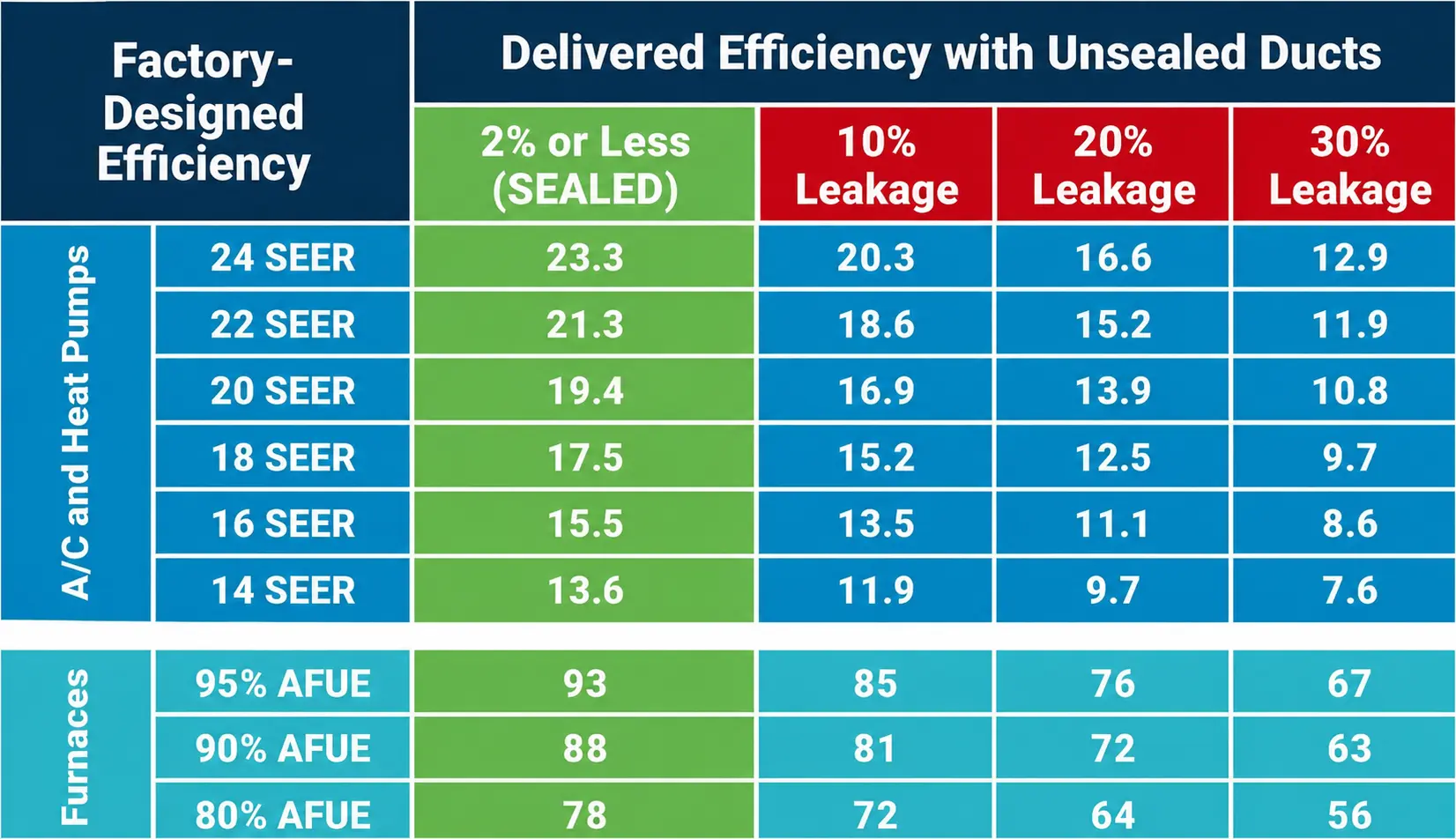
Delivered efficiency by equipment rating and duct leakage — chart supplied by Island AeroBarrier.
BENEFITS
What changes when more air reaches the right place?
More even temperatures
Fewer hot and cold spots between rooms and floors, because more of the conditioned air arrives where it was sent.
Stronger air delivery
Registers that were barely moving air have a better chance of doing the job they were installed to do.
Less wasted heating and cooling
Conditioned air stays in the ducts instead of feeding an attic or crawlspace.
Cleaner air distribution
Fewer return-side openings for dust, odours and unfiltered air to enter.
Better HVAC performance
The equipment operates closer to the efficiency it was rated for.
Less disruptive access
Hard-to-reach leaks are sealed from inside rather than by opening finished surfaces.
WHY ISLAND AEROBARRIER
Duct sealing should be measured, not guessed
Licensed and certified Aeroseal provider since 2018
Vancouver Island’s licensed and certified provider, serving residential and commercial buildings.
Tested before, tested after
Leakage is measured at the start, monitored during the process and verified at the end — with a report and certificate printed on the spot.
Led by Paul Moquin, President
Accredited Home Inspector, Natural Resources Canada Certified Energy Advisor, Level One Thermographer, and Mold and Indoor Air Quality Investigator.
Local to the Island
Based in Comox and Victoria, serving all of Vancouver Island, the Gulf Islands and parts of the Sunshine Coast.
Explained in plain language
You see the starting number, the finishing number, and what changed in between.
TEAM / PROJECT PHOTO
Real Island AeroBarrier crew or equipment on a Vancouver Island duct-sealing job. Recommended 1000×750. Stock photography is not to be used here.
CERTIFICATION BADGE ROW
Approved Aeroseal and certification marks only, at the resolution supplied by the client.
PRODUCT AND SAFETY
A safe vinyl acetate sealant designed for duct systems
Aeroseal duct sealing uses a vinyl acetate material formulated for sealing air leaks inside duct systems. Vinyl acetate polymer has also been used in water-based paints, adhesives, hair spray, chewing gum and baby pacifiers.
Before application the sealant is a water-based solution. Once dry, the material remaining in the duct system is primarily vinyl acetate polymer. It is distinct from the acrylic-based sealant used for building-envelope applications.
UL-listed for smoke and flame spread
UL 723, rated 0 / 0. Additional UL testing showed no signs of mould growth or erosion.
Stays flexible
The sealing material remains rubbery rather than becoming brittle, so it does not crack.
10-year warranty
The sealing material carries a 10-year warranty and an expected lifespan of over 40 years.
Seals the holes, not the ducts
The sealant collects at the leaks only — it does not coat the inside of the ductwork.
No lingering odour
A mild odour during application, similar to craft glue, dissipates within a few hours.
Proven technology
Patented from the University of California, with the process endorsed by the Environmental Protection Agency.
DEMONSTRATION
Watch the leaks close in real time
A short animation showing how the Aeroseal process seals a duct system from the inside.
Difficult-to-reach leaks are sealed from inside the ductwork
Leakage is monitored throughout the process
Final testing verifies the improvement
CUSTOMER EXPERIENCE
More comfort where it matters most — at home
★★★★★
5.0 from 18 Google reviews — Island AeroBarrier Inc
Paul was extremely knowledgable and professional throughout the process. He completed a very thorough inspection of our HVAC system and was able to provide a detailed review of the process and the benefits of the Aero Barrier process. He even identified a structural issue that we were able to get dealt with by the builder. On the day, his crew were highly professional, efficient and attentive.
Paul was able to provide me with the pre and post results of the sealing which showed an impressive improvement in the airflow in the ducting of the HVAC. Our house is a new construction !!
Paul and his crew were careful and cleaned up behind themselves.
We look forward to seeing the future benefits of an extremely sealed HVAC system !
We would highly recommend Island Aero Barrier.
Graham and Dora
This service is top of the line. They are very knowledgeable about the process and friendly answering all the questions I asked. You could see the progress on their computer program, which was cool and satisfying. The very next day house felt warmer and had less drafts. Also, the air that was flowing was warmer so the heat pump does not have to run as long to keep the house at temperature. They were respectful of our household items and made sure our cats were extra safe. I would recommend this process and this company if you want your house to feel warmer and perhaps use less energy.
I recently purchased a brand new house and opted to install a high end air filtration system. The installer suggested that if I wanted to get the best out of my upgrades that I should test the efficiency of the furnace and ducting. Island AeroBarrier performed a pressure test that showed just how much air was being lost and how it affected the overall performance of my equipment in spite of being newly installed. They remedied the problem with their high tech ingenuity and spray treatment. They were very professional and informative as they were able to show me in real time just how much the application was plugging any holes and improving the air flow and overall efficiency. We now have better equalized air flow to parts of the home furthest away from the furnace. I believe this improvement in function will also lead to lower operating costs. I would highly recommend their service to anyone with air ducts in their home regardless of age.
FAQ
Common questions about duct sealing
How do I know whether my ducts are leaking?
The symptoms are easier to notice than the leaks: a room that never warms up, weak airflow at certain vents, dust that returns quickly, or a system that runs for long stretches. The only way to know the actual number is a test. The first step of the Aeroseal process establishes an exact amount of leakage in the duct system, which gives you a scientifically valid measurement of how the system is performing.
My ducts have tape and mastic — doesn’t that mean they are sealed?
Not necessarily. Visible tape or mastic shows that someone sealed the accessible joints. It does not confirm the system is airtight, and it says nothing about joints inside walls, ceilings and floors. Island AeroBarrier commonly finds about 30% leakage in residential systems, including systems where tape or mastic is visible.
Do you need to open walls, ceilings or floors?
Aeroseal seals from inside the duct system, so ducts hidden from view can be sealed without opening finished surfaces to reach them. That is the main reason the process is far less disruptive than manual sealing.
What size of holes can be sealed?
Holes and cracks up to 5/8″ wide can be completely sealed.
How long does the service take?
REPLACE — typical duct-sealing duration and customer preparation requirements to be confirmed by Island AeroBarrier before launch. Do not publish an estimate.
Is the sealant safe?
Before application the sealant is a water-based solution. The dried material is primarily vinyl acetate polymer, which has been used in water-based paints, adhesives, hair spray, chewing gum and baby pacifiers. The sealant is UL-listed for smoke generation and flame spread (UL 723, 0/0), and additional UL testing showed no signs of mould growth or erosion.
There is a mild odour at the time of application, similar to craft glue, which dissipates within a few hours. Because the material does not off-gas over time, there is no lingering odour.
Are older duct systems the only ones that leak?
No. Duct age is not a reliable indicator. New and old systems can both leak, and because residential ducts are generally not leak-tested after construction, a newly built system can look sealed while still losing a significant amount of air.
How much could I save on energy?
Some homeowners have saved up to 40 percent on their energy bill. Exact savings are difficult to predict, because they depend on weather, the condition and design of the house, the heating and cooling system, how it is used, and energy prices. What can be stated precisely is the change in duct leakage, which is measured before and after the work.
Will duct sealing help with dust and indoor air quality?
Ductwork runs through attics, crawlspaces, basements, garages and walls. Leaking return ducts pull dust and other pollutants from those spaces into the central system, which then distributes them through the living areas. Sealing the return side reduces those openings.
I am planning a new heat pump or furnace — should I seal the ducts first?
It is worth measuring the ducts before committing to a higher-rated unit. Equipment ratings describe factory-designed efficiency; duct leakage determines how much of it reaches the rooms. Based on the comparison supplied by Island AeroBarrier, a 14 SEER system on sealed ducts delivers an effective 13.6 SEER, while a 24 SEER system on ducts with 30% leakage delivers an effective 12.9 SEER.
What do I receive when the work is finished?
A post-seal test is performed and a complete report and certificate are printed on the spot, providing a record of the improvement.
SERVICE AREA
Duct-sealing services across Vancouver Island
Island AeroBarrier is based in Comox and Victoria and serves all of Vancouver Island, the Gulf Islands, and parts of the Sunshine Coast.
Based in Comox and Victoria
Serving all of Vancouver Island, the Gulf Islands and parts of the Sunshine Coast.
CONFIRMED COMMUNITY LIST
The specific communities Island AeroBarrier wants named for local search and ad relevance. Only confirmed communities are to be added.
Request your free duct-sealing assessment
Stop paying to heat or cool air that never reaches you. Tell us what you are noticing — hot and cold rooms, weak airflow, high energy costs, dust, or a system that runs constantly — and we will help determine whether duct leakage is contributing to it.
WHAT THE FREE ASSESSMENT INCLUDES
Three or four short lines on what happens during the visit and what the homeowner receives. To be confirmed — do not draft speculatively.
Monday–Friday 8am–5pm
Saturday 9am–5pm